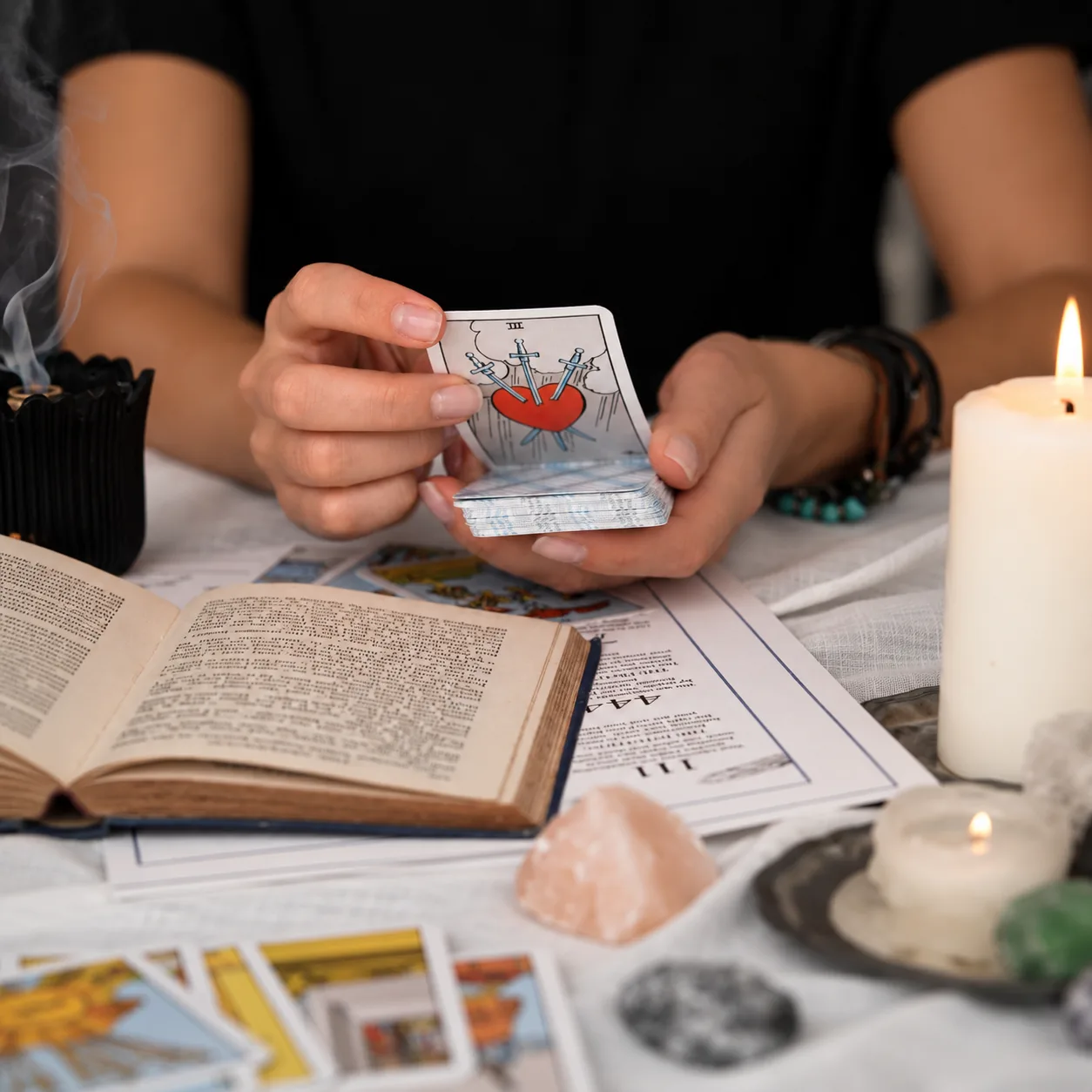
For many people, tarot begins with curiosity. Perhaps you are drawn to the imagery, fascinated by the idea of reading cards, or simply wondering whether tarot can really reveal something about your life.
But learning tarot is not only about predicting what might happen next. At its most meaningful, tarot can become a language for understanding what is already happening within you. Through symbols, archetypes, and stories, the cards invite us to look at our experiences from a different perspective, to notice patterns, question assumptions, and become more aware of the way we respond to life.
You do not need to be psychic to learn tarot, nor do you need to memorize all 78 cards before you can begin. Like learning any new language, understanding tarot develops gradually through study, observation, intuition, and practice.
So, beyond simply knowing what the cards mean, what can learning tarot actually give you?
1. You Learn to See Yourself More Clearly
We are often much better at recognizing patterns in other people's lives than in our own. The same relationship dynamic may repeat with different partners, the same fear may appear whenever a new opportunity arrives, or the same emotional reaction may follow us into completely different situations.
Tarot creates a little distance between ourselves and those experiences. When something internal is represented through an image or a spread of cards, it can become easier to observe.
A card such as the Eight of Swords, for example, may encourage us to question where we feel trapped and whether every limitation is truly external. The Four of Pentacles might raise questions about security, attachment, or our need to remain in control.
The card does not decide what these things mean for you. Instead, it gives you another perspective from which to explore them. In this sense, tarot becomes less like an instruction manual and more like a mirror—one that sometimes allows us to notice what we have been too close to see.
2. You Develop Intuition and Discernment
Tarot is often associated with intuition, but intuition does not necessarily mean receiving mysterious messages or possessing a special spiritual gift. Much of intuitive reading begins with something far simpler: learning how to pay attention.
When you look at a card, what catches your eye first? Which symbol feels significant? What emotion does the image create? Why does one detail seem particularly relevant to the question you are asking?
Over time, studying tarot can make you more attentive to these subtle responses. But it also teaches something equally important: discernment.
Not every strong feeling is intuition. Fear, expectation, projection, and wishful thinking can easily influence the way we interpret a situation. Becoming a thoughtful tarot reader means learning to recognize those differences rather than assuming that every instinct must be true.
The goal is not simply to trust yourself more. It is to understand yourself well enough to know what you are trusting.
Reserve Your Confidential Consultation
Protect your peace of mind and gain unvarnished clarity on your most private life dilemmas. Book an exclusive, discrete session with Madam Donna today.
3. You Learn to Ask Better Questions
Many people first approach tarot looking for certainty: Will this relationship work? Will they come back? Will my business succeed? What will happen next?
But the deeper you study tarot, the more your questions tend to evolve.
Instead of asking whether someone will return, you might begin wondering why you remain emotionally attached to the relationship. Instead of asking whether a career decision will succeed, you might explore what fear is influencing your decision or what part of the situation you have not considered.
This shift is subtle, but important. Tarot begins to move from simply asking the future for answers toward helping you understand your relationship with the present.
The cards may offer a different perspective, reveal a pattern, or introduce a possibility you had not considered. What they cannot, and perhaps should not, do is make every decision for you.
Learning tarot ultimately teaches us that a meaningful reading is not always the one that gives the most definite answer. Sometimes, it is the one that leaves us with a better question.
Tarot Is Something You Learn Over Time
You do not have to understand every card before beginning. Tarot has a structure that can be studied: the Major and Minor Arcana, four suits, numbers, court cards, symbolism, card combinations, and the relationship between cards within a spread.
At first, you may rely heavily on a guidebook. Eventually, individual meanings become familiar. With practice, you begin to see connections between cards rather than interpreting each one separately. What once looked like several unrelated images gradually becomes a story.
And perhaps that is the most interesting part of learning tarot. You may begin because you want to know how to read the cards, but somewhere along the way, you discover that tarot is also teaching you how to observe, question, listen, and reflect.
You learn the cards, but you also learn to read yourself.
Begin Your Tarot Journey with Madam Donna
At Madam Donna Tarot Reading Class, you will learn tarot beyond memorizing the meanings of 78 cards. We explore the structure and symbolism of tarot, how cards communicate with one another, how to build a reading into a coherent story, and how to develop your own intuitive approach while maintaining discernment.
Whether you want to use tarot for personal reflection or eventually read for others, you do not need to know everything before you begin. You simply need curiosity—and the willingness to look a little deeper.